

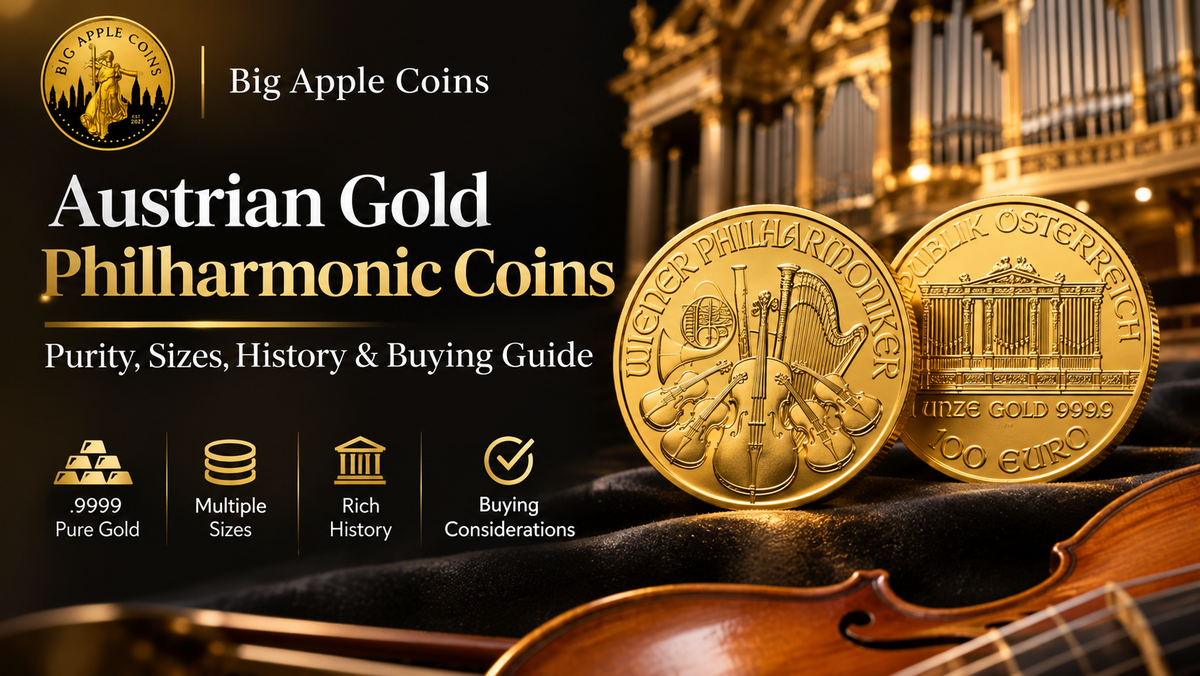
The Austrian Gold Philharmonic doesn't get the same name recognition in the US that the American Eagle does, but it's one of the most widely traded gold coins in the world. If you're weighing whether to add one to a bullion position, here's what actually sets it apart, and what to know before you buy.
A Quick History
The Austrian Mint, in operation since 1397, launched the Philharmonic in 1989 as its entry into the modern gold bullion market, initially in 1 oz and 1/4 oz sizes. It sold well from the start and became the top-selling gold coin in the world for several years in the early to mid-1990s. The design has never changed since launch: the Great Organ of Vienna's Musikverein Golden Hall on one side, a cluster of orchestral instruments, violins, a cello, a harp, a bassoon, a Vienna horn, on the other, honoring the Vienna Philharmonic Orchestra the coin is named for.
The only real change over the coin's history is its currency. Coins struck from 1989 to 2001 carry a face value in Austrian schillings. When Austria adopted the euro in 2002, the Philharmonic became the first gold bullion coin in the world denominated in euros, and it's carried that euro face value ever since.
Purity and Sizes
Every Philharmonic, regardless of size, is struck in .9999 fine gold, 24 karat. That's a meaningfully higher purity than coins like the American Eagle, which is 22 karat, or 91.67% fine. The tradeoff is that pure gold is softer, so Philharmonics show wear more easily than alloyed coins, which is worth knowing if you're buying with long-term storage in mind.
The coin comes in a full range of fractional sizes: 1 oz, 1/2 oz, 1/4 oz, 1/10 oz, and 1/25 oz, all sharing the identical design regardless of weight. The 1 oz size is the most commonly available and the one most buyers default to, but the fractional sizes give you flexibility if you want a lower entry point or plan to sell in smaller increments later.
Why It's Trusted Globally
The Philharmonic's reputation rests on the same foundation as any major sovereign coin: it's backed by a national mint, its specifications are guaranteed and haven't changed in decades, and dealers everywhere recognize it instantly. That last point matters more than it might seem. A coin with a consistent, unchanging design across 35-plus years of production is genuinely easier to resell than one that changes yearly, since every dealer, in every country, already knows exactly what they're looking at.
It's also legal tender in Austria and across the EU, which adds a layer of government backing beyond just the metal content, similar to how the American Eagle carries U.S. legal-tender status.
Philharmonic vs. American Eagle
Both are legitimate, widely traded sovereign coins, and the choice between them usually comes down to preference rather than a clear better option. The Philharmonic offers higher purity at .9999 fine and a strong international, especially European, following. The American Eagle is 22 karat, slightly more durable against wear because of its alloy, and carries deeper recognition specifically within the U.S. market.
For a buyer in the US, the Eagle is often the more familiar default, but the Philharmonic isn't a step down. It's simply built around a different set of priorities, purity and global reach over domestic familiarity.
What to Check Before You Buy
Purity and weight. Confirm you're getting genuine .9999 fine gold at the stated troy ounce weight, not a regular household ounce, which is a common point of confusion for first-time buyers.
Condition, if buying secondhand. Because the metal is pure and relatively soft, older or heavily circulated Philharmonics can show more wear than you'd expect from a similarly aged Eagle.
Premium over spot. Like any sovereign coin, the Philharmonic carries a premium above the live gold price. Compare that premium across sizes and dealers before buying.
Dealer reputation. Buy from a dealer who can speak knowledgeably about the coin's specifications and can verify authenticity in person.
Why Choose Big Apple Coins?
-
Expert appraisals. We evaluate Austrian Philharmonics and other world coins accurately, against live spot and current demand.
-
Competitive offers. Fair pricing whether you're buying or selling.
-
Instant payment. Cash, check, or wire, the same visit.
-
Convenient location. In the Diamond District, NYC's hub for gold world coins and foreign coins alike.
How to Buy or Sell With Us
-
Visit us at 55 West 47th Street, 4th Floor, Suite 430.
-
Get an appraisal. Bring in your coins for an on-the-spot evaluation.
-
Review our offer, priced from current market data.
-
Receive payment immediately once you accept.
Looking to buy gold bullion coins online first and pick up in person, or want to know what world coins for sale we currently carry? Contact us and we'll let you know what's in stock.
Tips for Buying Foreign Coins Like the Philharmonic
-
Confirm purity before comparing price. .9999 fine gold isn't directly comparable to 22 karat without adjusting for the difference.
-
Buy fractional sizes if flexibility matters to you. The full range gives you more control over how you sell later.
-
Expect more visible wear on older, circulated pieces given the coin's soft, pure gold content.
-
Buy from a dealer who knows world coins, not just domestic issues. Foreign coins for sale deserve the same scrutiny as anything else.
-
Don't assume unfamiliar means less valuable. The Philharmonic is one of the most traded gold coins on earth, even if it's less familiar to US buyers than the Eagle.
Visit Big Apple Coins Today
Whether you're adding an Austrian Gold Philharmonic to your collection or comparing it against other sovereign coins, come talk it through with us in the Diamond District.
Big Apple Coins 55 West 47th Street, 4th Floor, Suite 430 New York, NY 10036 (212) 321-0073 · info@bigapplecoins.com Monday–Thursday 10:00 AM–6:00 PM · Friday 10:00 AM–5:00 PM
Get a free appraisal or browse our gold bullion in person.
This article is general information, not investment advice.


Share:
Should You Sell a Rare Coin Collection All at Once or Piece by Piece?