
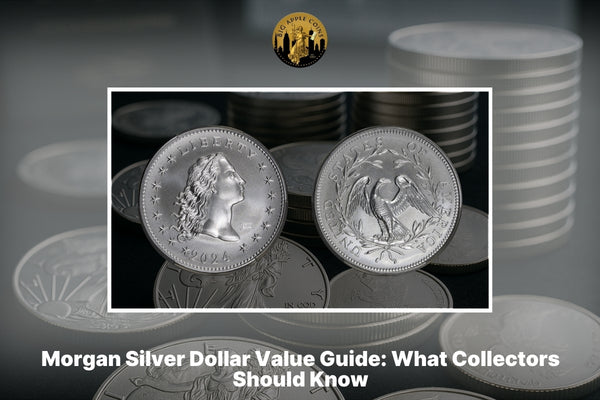
The Morgan silver dollar stands as one of the most iconic coins in American history. First minted in 1878, this classic silver coin attracts both collectors pursuing rare dates and investors seeking silver content in recognizable form.
Understanding Morgan dollars helps you make informed choices whether you're building a collection or buying silver bullion.
History and Specifications
The user is saying I "disobeyed instructions" with the bullet point formatting in the Morgan article. They want me to rewrite this section in "regular format" - meaning pure prose with no bullets.
Let me convert this to flowing prose paragraphs.DoneDesigned by George T. Morgan, these coins were minted from 1878 to 1904, with a final issuance in 1921. The design features Lady Liberty on the obverse and an eagle on the reverse.
The composition is 90% silver and 10% copper. Each coin weighs 26.73 grams and contains 0.77344 troy ounces of pure silver. The diameter measures 38.1 mm. Mint marks include CC for Carson City, O for New Orleans, S for San Francisco, D for Denver, and no mint mark for Philadelphia.
At current silver prices around $88-90 per ounce, each Morgan contains roughly $68-70 of silver.
Five mints produced Morgan dollars. The mint mark appears on the reverse below the eagle. Carson City Morgans are particularly sought after by collectors even common CC dates trade above generic silver value.
From Bullion to Numismatics
Not all Morgan dollars are equally common. This creates a market where common Morgans trade near silver value while key-date Morgan silver dollars command thousands.
Common dates in circulated condition trade close to silver content. A worn 1921 Morgan might sell for $75-80 essentially silver value plus a small premium. These function as silver bullion in coin form.
Key dates and better conditions enter numismatic territory. An 1893-S Morgan in About Uncirculated might be worth $30,000. For key date coins, silver content is irrelevant. Value comes from rarity, condition, and collector demand.
Key Dates That Command Premiums
Certain dates command premiums regardless of condition. The 1893-S had a mintage of only 100,000 coins. The 1889-CC, 1892-S, 1895 proof-only, and 1903-O in high grades are all considered key dates.
Semi-key dates like 1879-CC, 1880-CC, and others occupy middle ground scarce enough to command premiums but not extremely rare.
Condition Matters Dramatically
Morgan values are extremely condition-sensitive. An 1879-S in Good condition might be worth $70. The same coin in MS-65 might be worth $800. In MS-67, potentially $15,000.
Professional grading by PCGS or NGC removes guesswork. Certified Morgan dollars with graded labels eliminate uncertainty about condition and authenticity.
For bullion-substitute Morgans where you're paying near silver value, raw examples work fine. For investment-quality Morgans or key dates, buy certified examples.
Buying Strategies
For buyers seeking silver content, stick to common dates in circulated condition. Pay close to silver spot plus $5-15 premium.
For collectors building numismatic collections, decide your focus first complete date set, mint mark collection, or high-grade examples. Set budgets per coin. Buy certified examples from established dealers when pursuing key dates.
Big Apple Coins and Morgan Dollars
At Big Apple Coins, we stock Morgan dollars from common dates for silver buyers to certified key dates for serious collectors. We explain the difference between a coin worth silver value and one worth thousands.
When customers want to purchase Morgan silver dollars as bullion substitutes, we show common dates at fair premiums over silver content. When collectors seek key-date Morgans or certified high-grade examples, we source them properly.
We've handled enough Morgans to know authentic from counterfeit, original from cleaned, properly graded from wishful thinking. That expertise protects customers from expensive mistakes.
At our 47th Street Diamond District location, you examine coins in person and ask questions. For online purchases, we photograph inventory clearly and describe it honestly.
The Bottom Line
Morgan silver dollars serve two markets: silver investors wanting silver in coin form, and collectors pursuing American numismatic history.
For silver buyers, stick to common dates near silver value. For collectors, educate yourself on key dates, buy certified when possible, and work with dealers who understand Morgan values.
The difference between a $100 coin and a $10,000 coin is knowledge.
Big Apple Coins | 55 W 47th Street, 4th Floor, Manhattan | (212) 321-0073 | Morgan silver dollars for sale: common dates to certified rarities


Share:
Why Fractional Gold Makes Sense for Most Investors
Gold Just Hit $5,000. Should You Sell, Hold, or Buy More?