
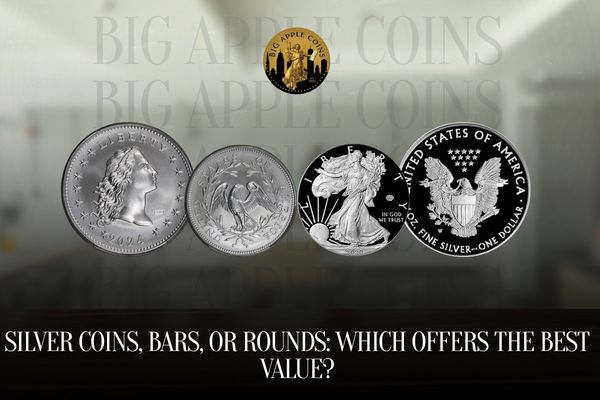
Silver keeps drawing in both investors and collectors, but once you decide to buy, a second question comes up fast: which form of silver actually makes the most sense? Coins, bars, and rounds all get you the same underlying metal, but the differences between them affect price, resale, and how much you'll actually enjoy owning them. Here's how to think it through.
The Three Forms of Silver
Silver coins are legal tender struck by official government mints think the American Silver Eagle, the Canadian Maple Leaf, or the Austrian Philharmonic. Because they carry sovereign backing and official mint status, they're the most universally recognized form of silver and tend to be the easiest to sell anywhere in the world. That recognition comes at a cost, though, in the form of a higher premium.
Silver bars are produced by private refiners like PAMP Suisse and Valcambi rather than government mints. They're built for one purpose: getting the most silver for your money. Available from a single ounce up to 100 ounces or more, bars are the go-to choice for investors focused purely on stacking weight efficiently.
Silver rounds sit in between. Like bars, they're privately minted rather than issued by a government but they're shaped and sized like coins, often featuring original or commemorative designs. Rounds typically carry a lower premium than coins while still offering some of the design appeal that draws collectors to coins in the first place.
Premiums: Where the Real Differences Show Up
The premium the markup over the live spot price of silver is where these three categories really separate from each other.
Coins generally carry the highest premiums, often landing somewhere in the 10–15% range over spot. That premium reflects the official government backing and the strong resale demand that comes with it.
Rounds and bars usually end up being cheaper, typically 5-10% over spot, with premiums on larger bars going down to around 2-3% depending on size, offering a reasonable balance between price and the kind of artistic or thematic design that makes a piece feel like more than just a stack of metal. However, specific rounds and bars with collectibility may have significant premiums, ranging from 20-50% over spot and potentially even higher.
Liquidity: How Easily Can You Sell It Later?
How easily you can resell your silver matters just as much as what you pay for it upfront.
Government-minted coins like the Silver Eagle or the Britannia are instantly recognizable to buyers and dealers everywhere, which tends to translate into the strongest liquidity and the best buyback terms.
Rounds can usually be sold just as quickly, though resale value can vary a bit more depending on the specific mint and design less standardized recognition than an official coin, but still broadly accepted.
Bars are widely accepted by dealers and institutions too, but larger bars sometimes require an assay or extra verification before a buyer will commit, which can slow things down slightly compared to coins.
Storage Considerations
Each format has its own practical quirks when it comes to storage. Bars stack efficiently and take up relatively little space for the weight they hold, making them convenient for investors building up larger holdings over time. Coins and rounds, on the other hand, are more prone to surface scratches and benefit from protective tubes or cases to keep their condition and their resale value intact. Regardless of which you choose, secure and insured storage, whether at home, in a safe deposit box, or through a dedicated vaulting service, is worth factoring into your plan from the start.
Collectible Appeal vs. Pure Investment Efficiency
If your only goal is accumulating as much silver as possible for your budget, bars are usually the most efficient route low premiums, easy stacking, straightforward math. But coins and rounds bring something bars don't: collectible and aesthetic appeal that can add value beyond the metal itself. Limited releases, proof strikes, and well-designed rounds can appreciate in ways that go beyond the daily silver price, giving collectors a potential edge that a plain bar simply won't offer.
So Which Should You Buy?
It really comes down to your priorities:
-
Choose coins if liquidity, official recognition, and strong resale value matter most to you.
-
Choose bars if your main goal is getting the most ounces for your money.
-
Choose rounds if you want an appealing middle ground lower premiums than coins, with more design variety and character than a plain bar.
Many silver buyers end up holding a mix of all three bars for efficient accumulation, coins for liquidity and recognition, and rounds for variety and value.
Buy Silver Bullion for Sale at Big Apple Coins
Whatever direction you lean, Big Apple Coins can help you find it. We're located in the heart of Midtown Manhattan's Diamond District, and we carry a wide selection of silver bullion for sale including silver rounds for sale, silver bars for sale, and government-minted coins from mints around the world.
If you're searching for a silver dealer near me, our in-person experience lets you see and compare your options firsthand before you decide. And if you'd rather buy silver bullion online, our team is happy to help you find exactly what you're looking for without ever needing to visit the store.
Final Thoughts
There's no single "best" way to own silver coins, bars, and rounds each serve a different purpose depending on what you're trying to accomplish. Understanding the tradeoffs in premium, liquidity, and collectibility is the key to building a silver position that actually fits your goals. Stop by Big Apple Coins in Midtown Manhattan and let our team help you figure out the right mix for your portfolio or collection.
Whether you’re buying or selling silver in NYC, we’re here to help. Visit Big Apple Coins at 55 W. 47th Street, Suite 430 in Midtown Manhattan Monday through Thursday, 11 AM to 6 PM, and Friday, 11 AM to 5 PM. Our team is here to help you with great prices, no pressure and full transparency.


Share:
Why Rare Coins Are a Smart Investment: What to Buy for Long-Term Profit
Best Places to Buy Gold Coins Online & Locally (Trusted Dealers Guide)