
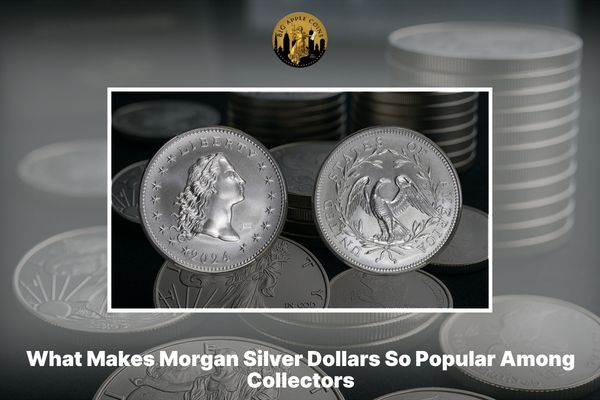
Few coins occupy the place in American collecting culture that the Morgan Silver Dollar does. Even people with no real interest in coins tend to recognize the name. Part of that comes from sheer history — Morgans circulated during a pivotal era when silver and gold, not government promises, backed American currency. Part of it comes from the coin itself: a substantial, beautifully designed piece of real silver that's remained accessible to collectors for well over a century. Here's the story behind the coin, and what makes it worth adding to a collection today.
A Brief History of the Morgan Dollar
The Morgan Dollar takes its name from its designer, George T. Morgan, and was the first silver dollar struck after Congress effectively demonetized silver in the Coinage Act of 1873. Its return to circulation came out of the Bland-Allison Act of 1878, which required the U.S. Treasury to purchase large quantities of silver — much of it from Nevada's Comstock Lode — and turn it into coinage. The Mint struck Morgans from 1878 through 1904, paused, then briefly resumed in 1921 before handing the silver dollar design over to the Peace Dollar.
Over that run, the Mint produced more than 657 million Morgan Dollars across 96 different date-and-mint combinations, primarily out of Philadelphia, with additional output from New Orleans, San Francisco, Carson City, and (in 1921 only) Denver. Carson City's run ended when that mint closed in 1893, and the relative scarcity of its output has made CC-marked Morgans some of the most desirable coins in the entire series.
The decades that followed brought repeated waves of melting and rediscovery. Wartime silver demand under the Pittman Act of 1918 led to nearly 270 million Morgans being melted down. More were melted following the Silver Act of 1942. Yet huge quantities also sat untouched in bank and Treasury vaults for decades — including a hoard of roughly 400,000 coins discovered in collector LaVere Redfield's home in 1977, which sold for $7.3 million. That pattern of melting and hoarding is part of why some Morgan dates are common today while others are genuinely rare.
The rarest of them all is the 1895 Philadelphia Morgan, often called the "King of Morgans." Only 880 of the original 12,880 struck are believed to have survived the melting pot, with perhaps 500 or fewer existing today.
In 2021, the U.S. Mint released commemorative 100th-anniversary Morgan and Peace Dollar reissues in .999 fine silver a modern nod to a coin that, more than a century after its debut, still captures collector imagination.
Real Silver, Real Substance
Each original Morgan Dollar contains 90% silver and 10% copper, for a total of .7734 troy ounces of pure silver in a coin just over an inch and a half across. That composition is part of the appeal: a Morgan isn't just a historical curiosity, it's also a tangible chunk of precious metal that tracks with the silver market even at its most common dates.
Why Collectors Still Chase Morgans Today
History you can hold. Few coins connect as directly to a specific era of American monetary policy the silver boom of the American West, the bimetallism debates of the late 1800s, two world wars' worth of silver demand.
A genuinely deep, organized market. With 96 date-and-mint combinations and well over a century of recorded sales, pricing and grading standards for Morgans are about as well-established as any series in American numismatics. Whether you're after a common date or a true rarity, there's a clear way to know what you're paying for.
Real variety in rarity and price. Common dates like the 1904-O are affordable and widely available, while key date Morgans — the 1893-S, the 1889-CC, and above all the 1895 — can command thousands of dollars or more, giving collectors entry points at every budget.
Strong, sustained demand. Generations of collectors have built complete date-and-mint sets, and that demand hasn't faded with time the way some other historic series have.
Certified vs. Raw Morgans
For anything beyond a basic, common-date piece, buying certified — meaning graded and sealed by PCGS or NGC — is worth the extra step. Slabbed Morgan dollars come with a verified grade on the Sheldon scale, protection from further wear, and a level of trust that makes resale far easier down the line. For key date Morgans especially, certification isn't just a nice-to-have, it's close to essential given how much counterfeiting risk exists around the series' most valuable dates.
Buy Morgan Silver Dollars at Big Apple Coins
If you're ready to add a Morgan to your collection — or build a full date-and-mint set — Big Apple Coins carries a rotating selection of Morgan silver dollars for sale, from affordable common dates to scarce key date Morgan dollars. We're located in the heart of Midtown Manhattan's Diamond District.
Whether you're looking to buy Morgan dollars for the first time or you're searching specifically for certified pieces backed by PCGS or NGC, our team can help you understand exactly what you're looking at and find the right piece for your collection or your budget. Come to our retail shop and take a look at our wide selection of slabbed or raw coins at great prices. Take your time, ask questions, and decide with no pressure.
Looking for Morgan Dollars in NYC? We're here to help. Visit Big Apple Coins at 55 W. 47th Street, Suite 430 in Midtown Manhattan — Monday through Thursday, 11 AM to 6 PM, and Friday, 11 AM to 5 PM. Our team is here to help you with rare US coins at great prices, with no pressure and full transparency.


Share:
The Certified Coin Label: Why It's the Most Important Part of Any Rare Coin Purchase