
If you have decided to buy gold and started shopping, you have probably noticed that dealers list "gold coins" and "gold bullion" as if they were two different things. They aren't, quite. The categories overlap, and the places where they don't overlap are the places that affect what you pay and what you get back when you sell.
At Big Apple Coins in Manhattan's Diamond District, this is one of the most common questions we get across the counter. Here is the plain version.
What Gold Bullion Actually Means
Bullion is gold valued for its metal content rather than its rarity. Bars, rounds, and modern government-minted coins all fall under it. Whatever form it takes, the price tracks the live spot price of gold plus a premium covering refining, minting, and distribution.
Most modern gold bullion is .999 fine or better. Bars sit closest to melt value and give you the most weight per dollar, and the larger the bar, the lower the premium per ounce. Rounds behave the same way but carry no legal tender status.
Where Coins Fit
The confusion in the gold coins vs bullion question comes from treating coins as the opposite of bullion. Most gold coins are bullion. It helps to split them in two.
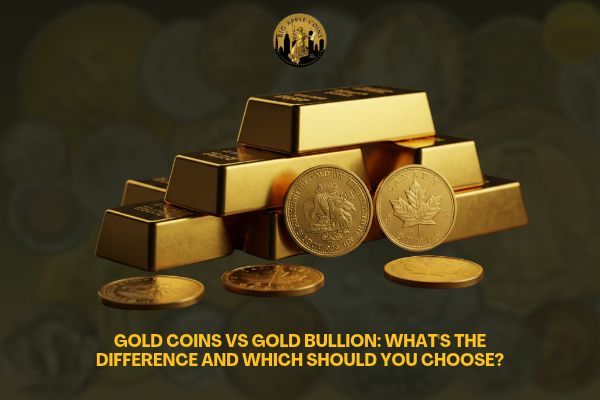
Bullion coins are struck by national mints with a guaranteed weight and purity and a stamped face value. The American Gold Eagle and Canadian Gold Maple Leaf are the obvious examples. They trade on metal content, just at a somewhat higher premium than a bar in exchange for that government backing. Worth noting: the Eagle is 22 karat, .9167 fine, while the Maple Leaf is .9999.
Numismatic coins are priced on rarity, mintage, age, and condition rather than weight. A scarce date in high grade can bring many times its melt value. PCGS and NGC grades drive much of that pricing, which is why condition matters so much in this category.
The Differences That Cost You Money
Premium. Bars are cheapest per ounce. Bullion coins sit in the middle. Numismatic coins are the most expensive, because you are buying scarcity on top of metal.
Liquidity. Recognized bullion coins are among the easiest gold to sell anywhere in the world. Any dealer knows a Gold Eagle on sight. Bars are liquid too, though a large bar can be awkward when you only want to sell part of your position.
Divisibility. This quietly favors coins. Fractional gold coins let you sell in pieces instead of liquidating a full ounce or more at once.
IRA eligibility. The IRS requires at least .995 fineness for gold in a precious metals IRA, with the 22 karat American Gold Eagle carved out as a specific exception. Most graded collectible coins do not qualify. If a retirement account is part of your plan, check eligibility before you buy rather than after.
So Which Should You Choose?
Match the product to the job.
If you want maximum weight for your money and plan to hold long term, buy gold bullion in bar form and keep your premium low. If you want liquidity and the ability to sell in pieces, look at gold bullion coins for sale from the major mints. If you enjoy history and want a shot at collector upside, set aside a smaller portion for numismatic pieces and accept that they take longer to sell.
Plenty of people do all three. A core of low-premium bullion for weight, a handful of recognized coins for flexibility, and a few collectibles for interest is a reasonable structure.
Buying in Person vs Buying Online
You can buy gold bullion coins online from any number of national dealers, and for pure bullion that works fine. Where it stops working is condition-sensitive material. Photographs do not tell you much about a coin's surfaces, and grading disputes are considerably easier to resolve when you and the coin are in the same room.
That is the case for buying locally. Come in, look at the actual piece, ask why it is priced the way it is, and walk out with it the same day.
Why Choose Big Apple Coins?
-
Expert appraisals. We evaluate bullion and numismatic gold accurately, against live spot and current market values.
-
Competitive offers. Pricing from real market data, whether you are buying or selling.
-
Instant payment. Cash, check, or wire the same visit.
-
Convenient location. In the Diamond District, the center of precious metals trade in New York.
How to Buy or Sell Gold at Big Apple Coins
-
Visit us at 55 West 47th Street, 4th Floor, Suite 430.
-
Get an appraisal. Bring your coins or bars and we will evaluate them on the spot.
-
Review our offer, based on current market pricing.
-
Receive payment immediately once you accept.
Selling rather than buying? Request a free appraisal with photos and quantities and we will send a no-obligation estimate.
Tips Before You Buy Gold Coins
-
Compare the all-in premium, not the sticker price. Work out your cost per ounce over spot before committing.
-
Stick to recognized products. Eagles, Maple Leafs, Krugerrands, and major-refiner bars resell easily. Obscure issues do not.
-
Buy the grade, not the story on numismatic material. Certified coins from PCGS or NGC remove most of the guesswork.
-
Confirm IRA eligibility first if the gold is headed for a retirement account.
-
Store securely and keep your receipts. Provenance helps at resale.
Visit Big Apple Coins Today
Whether you want to buy gold coins, add bullion to a long-term position, or sell gold you already own, come see us in the Diamond District.
Big Apple Coins 55 West 47th Street, 4th Floor, Suite 430 New York, NY 10036 (212) 321-0073 · info@bigapplecoins.com Monday–Thursday 10:00 AM–6:00 PM · Friday 10:00 AM–5:00 PM
Get a free appraisal or browse our gold bullion in person.
This article is general information, not investment or tax advice.


Share:
Platinum vs. Palladium in 2026: Which Precious Metal Offers Better Value for Bullion Buyers?