

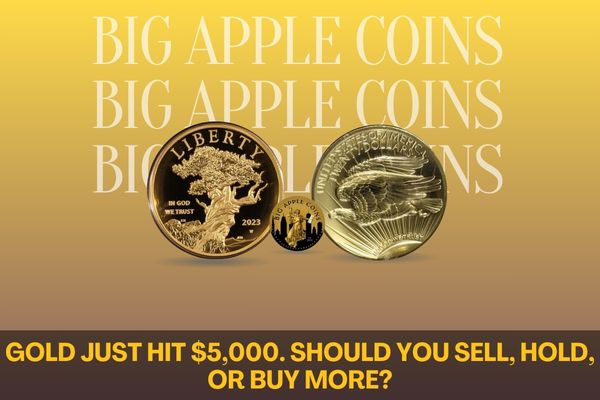
On January 28, 2026, gold reached $5,602.22 per troy ounce an all-time record. If you own gold coins, bars, or jewelry, you're sitting on gains that would have seemed impossible three years ago.
Now comes the hard question: do you sell, hold, or buy more?
There's no universal answer. But there's a framework that helps.
How We Got Here
Gold didn't wake up one morning and decide to run. The rally has been building for years, driven by forces that don't simply disappear.
J.P. Morgan's private bank recently noted that gold has surged more than 170% over the past five years, pointing to geopolitical volatility and global fragmentation as the biggest drivers. Add a dollar that fell 9.5% in 2025 its worst year since 2017 alongside central banks buying gold at record pace and tariff uncertainty rattling traditional portfolios, and you have a near-perfect environment for gold.
The move from roughly $2,600 at the start of 2025 to $5,602 in late January 2026 reflects all of that compounding at once.
The Case for Selling Now
If you bought gold at $1,500, or inherited coins years ago, you're looking at gains that are extraordinary by any historical measure. Locking those in is not a foolish move.
Selling makes particular sense if you need liquidity, carry high-interest debt, or have no cash emergency fund. Gold sitting in a safe earns nothing. Converting some of it to working capital has real logic.
The key word is some. Very few advisors recommend liquidating an entire position at once particularly in an asset with the structural fundamentals gold currently has.
The Case for Holding
The forces behind this rally haven't reversed. Dollar debasement, geopolitical instability, and central bank demand are multi-year stories, not short-term headlines. Gold pulled back from its January peak before stabilizing near $5,000 showing buyers are waiting at lower levels.
If your gold position is a long-term hedge rather than a trading vehicle, nothing about the current environment suggests abandoning that strategy.
The Case for Partial Sales
This is where most people land. Sell the straightforward bullion the American Eagles, the Maple Leafs, the Krugerrands. These trade close to spot price and you can capture the rally cleanly. Hold the rare numismatic pieces, which carry collector premiums on top of gold's value and may appreciate independently.
The mistake to avoid: selling everything in one rushed conversation with the first dealer who makes an offer.
Before You Do Anything
Get a proper appraisal from a dealer who understands numismatics, not just one who buys gold by weight. With gold over $5,000, the difference of a few percentage points is the difference between a good deal and a bad one.
At Big Apple Coins on 47th Street in Manhattan's Diamond District, we examine every coin individually dates, mint marks, condition and show you current spot prices in real time. Written quotes, no pressure. Whether you sell that day or come back in three months, the goal is the same: you understand exactly what you have.
The Bottom Line
Gold at $5,000 is a genuine windfall for anyone who held through the last few years. That doesn't mean you have to act immediately, or act all at once. The coins will still be valuable tomorrow. The decision should match your financial situation not the anxiety of watching a number move on a screen.
* This is not to be construed as professional financial advice.
The Gold-to-Silver Ratio: The One Number Every Precious Metals Investor Should Know
There's a number that serious precious metals investors check the way stock traders check the VIX. It's called the gold-to-silver ratio, and right now it's telling an unusually interesting story.
What It Is
The gold-to-silver ratio is simple: divide the current price of gold by the current price of silver. The result tells you how many ounces of silver it takes to buy one ounce of gold.
When gold is trading at $5,000 and silver at $90, the ratio is roughly 55:1. When gold was $2,000 and silver was $25, the ratio was 80:1. The number moves constantly, and investors have tracked it for centuries in some form, it dates back to ancient Rome.
Why It Matters
The ratio is a relative value tool. It doesn't tell you whether precious metals overall are cheap or expensive. What it tells you is which metal is cheap or expensive compared to the other.
Historically, over modern markets, the ratio has averaged between 60:1 and 70:1. When it climbs significantly above that range, silver looks undervalued relative to gold. When it drops well below it, gold looks cheap relative to silver.
In April 2020, during peak COVID panic, the ratio hit an all-time high of 125:1. It's one of the most extreme readings ever recorded. What happened next: silver dramatically outperformed gold over the following 18 months as the ratio mean-reverted.
Where We Are Now
In early 2025, the ratio was back above 100:1, with gold surging on tariff fears while silver lagged. Then came silver's explosive rally: prices climbed from the $30s all the way to a nominal all-time high of $121.67 on January 29, 2026. The ratio compressed rapidly falling to roughly 50:1 at the peak before bouncing back toward 55–60:1 as silver corrected.
That compression from 100:1 to 50:1 in roughly nine months is one of the most dramatic ratio moves in modern history. Investors who rotated from gold to silver when the ratio was near 100 captured significant outperformance.
How Investors Use It
A common rule of thumb: when the ratio is above 80, silver looks relatively attractive. When it falls below 50, gold may offer better relative value. Some investors use this as a signal to rotate between the two metals over time not chasing price momentum, but chasing relative value.
The strategy requires patience. The ratio can take months or years to move. And it's one input, not the whole picture the fundamentals of each metal matter too.
What It Means at Big Apple Coins
When you walk into our 47th Street location, we look at both metals every day. We track spot prices in real time and understand how the ratio affects what buyers are looking for and what sellers should consider.
If you're deciding between adding gold or silver to your collection or trying to figure out whether to sell one and hold the other the ratio is part of the conversation we'll have. It's one of the tools that separates a real precious metals dealer from someone who just buys metal by weight.


Share:
Morgan Silver Dollar Value Guide: What Collectors Should Know
Silver After the Crash: Is Now the Time to Buy or Sell?